This article was written by Vamos Web Design Agency in Bristol as a guest contribution to Nexus Blueprint. It explores how SMEs can plan website architecture around business strategy rather than internal structure — covering page design, content ownership and conversion paths.
The structure of a website should reflect what a business actually sells, who it serves and what it needs visitors to do next. For many SMEs, however, the website gradually becomes disconnected from the business it is supposed to represent.
That matters because a website is not just a collection of pages. It is part of the wider business system. It introduces services, explains expertise, answers questions, supports sales conversations and gives potential customers somewhere to take the next step. If the company changes but the website does not, those roles become harder to fulfil.
Key Takeaways
- Website pages should reflect real business priorities rather than simply copying an internal organisation chart.
- Important services and value propositions need clear destinations that customers can understand.
- Key areas of website content should have someone responsible for keeping them accurate.
- Website conversions should reflect useful business outcomes rather than one generic action.
- Website structure should be reviewed as services, markets and priorities change.
In This Article
- Why the Structure of a Website Should Follow Business Strategy
- Start With How the Business Creates Value
- Turn Business Priorities Into Page Architecture
- Give Website Content Clear Ownership
- Build Conversion Paths Around Business Outcomes
- A Typical SME Website Scenario
- Signs Your Website No Longer Reflects the Business
- Final Thoughts
- Frequently Asked Questions
Why the Structure of a Website Should Follow Business Strategy
It is easy to think about website structure as a design task. A business decides which pages it wants, groups them into a navigation menu and then starts thinking about layout. That approach can work for a simple site, but it can also hide a more important question: what does the business need the website to do?
Nielsen Norman Group distinguishes information architecture from navigation. Information architecture covers the content, functionality and relationships underneath the interface, while navigation is the visible system people use to move through it. A neat menu does not necessarily mean the underlying website has been organised well.
When the structure of a website is based only on what fits neatly into a menu, commercially important services can end up buried, several pages can compete for the same purpose, and visitors may struggle to understand how the different parts of the business relate to one another.
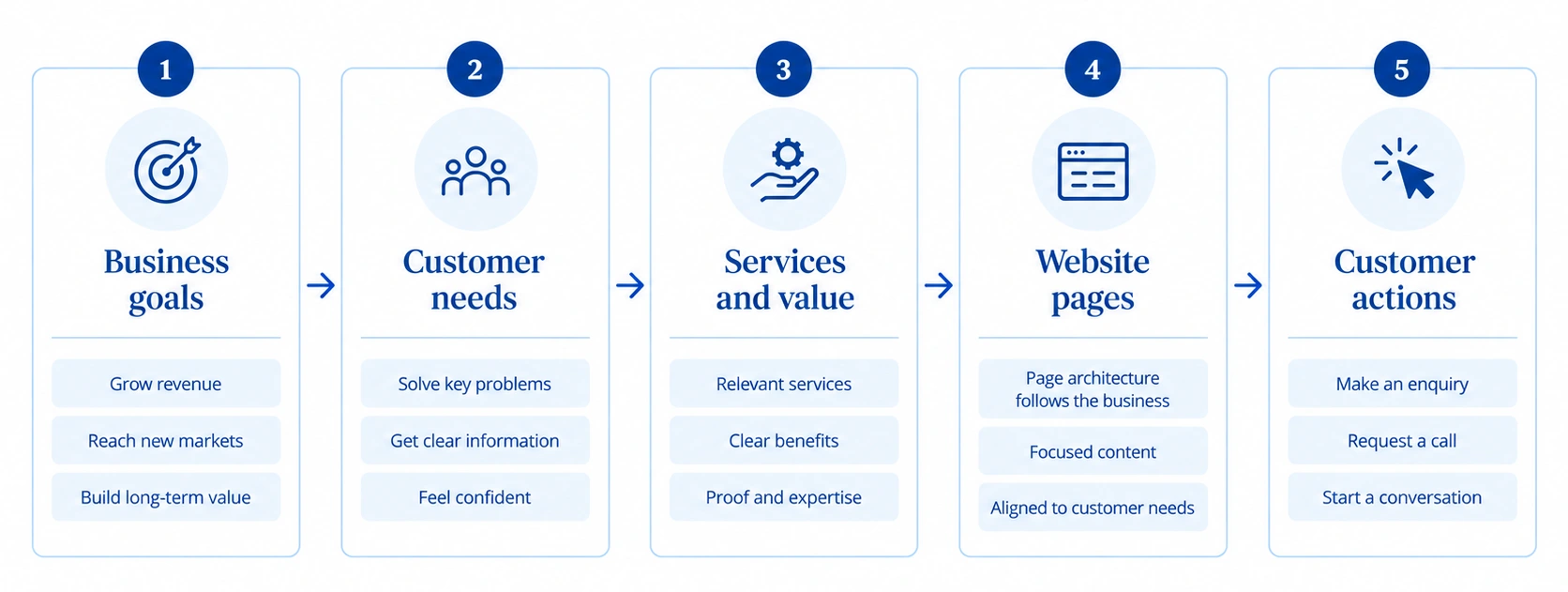
A better starting point is the business itself. What does it sell? Which customers matter most? Where does it create value? Which areas are expected to grow? What does a good enquiry or customer action look like? Those questions turn website structure from a design exercise into a practical business decision.
Start With How the Business Creates Value
Before planning pages, it helps to understand how value moves through the business. For an SME, this may be straightforward on paper but less obvious once several services, customer groups or routes to market have developed.
A consultancy might earn most of its revenue from three core services but still have an old website built around one broad "What We Do" page. A manufacturer might sell to distributors, contractors and direct commercial buyers, yet present the same information to all three. A professional services firm may have grown into several specialist areas without giving each one a clear place on the site.
Planning the structure of a website from the business model helps reveal where separate pages, supporting content or clearer pathways are genuinely needed.
Map the Main Offers and Customer Needs
Start with what customers are actually buying and the problem they are trying to solve. This usually gives a more useful basis for the website than starting with internal departments.
Nexus Blueprint's Growth Action Planning approach looks at current performance, growth levers, priorities, measurable goals and named owners. Website planning benefits from the same kind of clarity: if a service is commercially important, the site should make that importance visible rather than leaving it hidden several clicks deep.
This does not mean every service needs a large section of its own. The point is to decide deliberately which offers deserve dedicated pages, which can sit together and what supporting information customers need around them.
Do Not Simply Copy the Company Structure
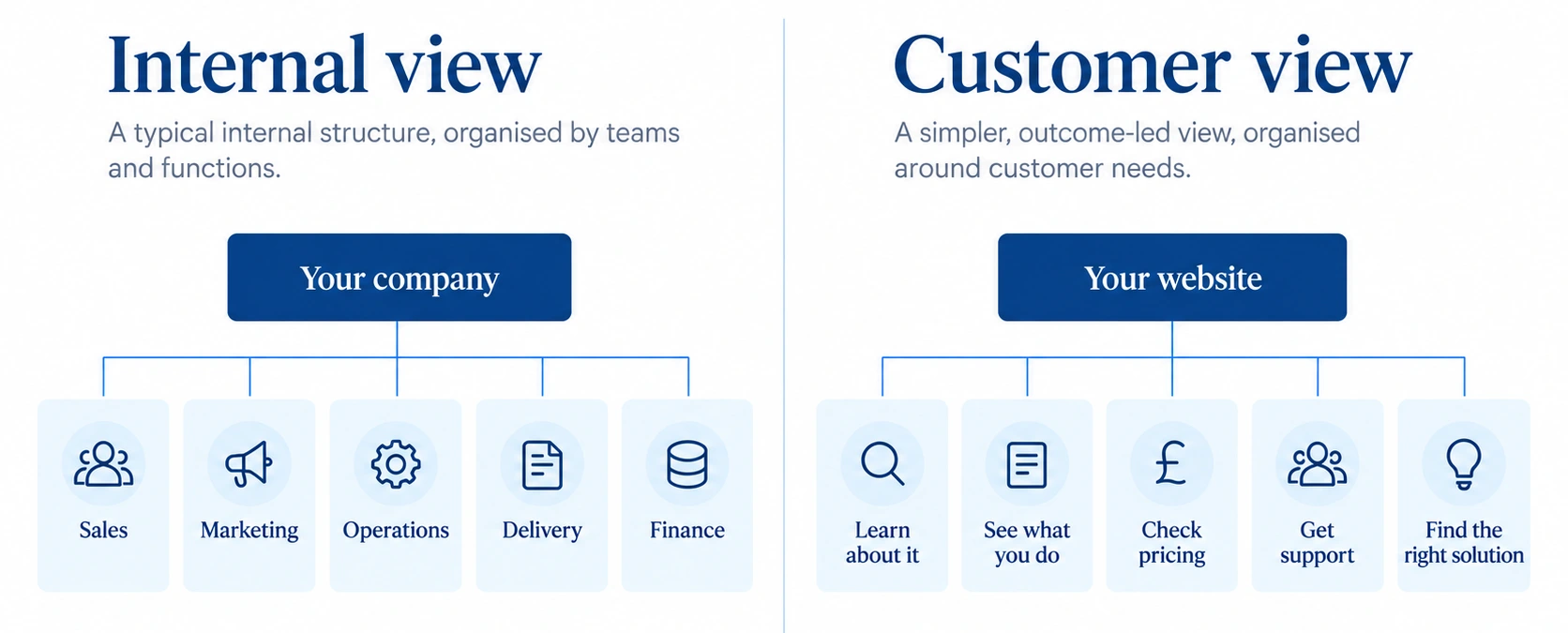
Internal structures are useful for running a business, but customers do not necessarily think in the same terms. Labels such as "Operations", "Commercial", "Technical" or "Solutions" may be perfectly clear to employees and still mean very little to a first-time visitor.
Customers are more likely to think about the service they need, the problem they have or the outcome they are trying to achieve. A good website hierarchy often translates the internal business into customer-facing language rather than reproducing it exactly.
Turn Business Priorities Into Page Architecture
Once the business priorities are clear, they can be translated into page roles. A useful way to think about the structure of a website is to ask what each important page contributes. Some pages explain a service. Some establish proof. Some answer an early question. Some help visitors compare options. Others exist mainly to move the right visitor towards an enquiry, booking or another meaningful action.
This is where page architecture becomes more than a sitemap. It becomes a way of connecting business priorities to customer journeys.
| Business priority | Website role | Content owner | Useful conversion |
|---|---|---|---|
| Grow a core service | Dedicated service page | Service lead | Qualified enquiry |
| Support existing customers | Resource or support area | Operations or customer team | Support action |
| Build expertise | Guide or insight content | Subject expert and marketing | Relevant next page |
| Enter a new market | Sector or solution page | Commercial lead | Enquiry or meeting request |
Give Important Services a Clear Destination
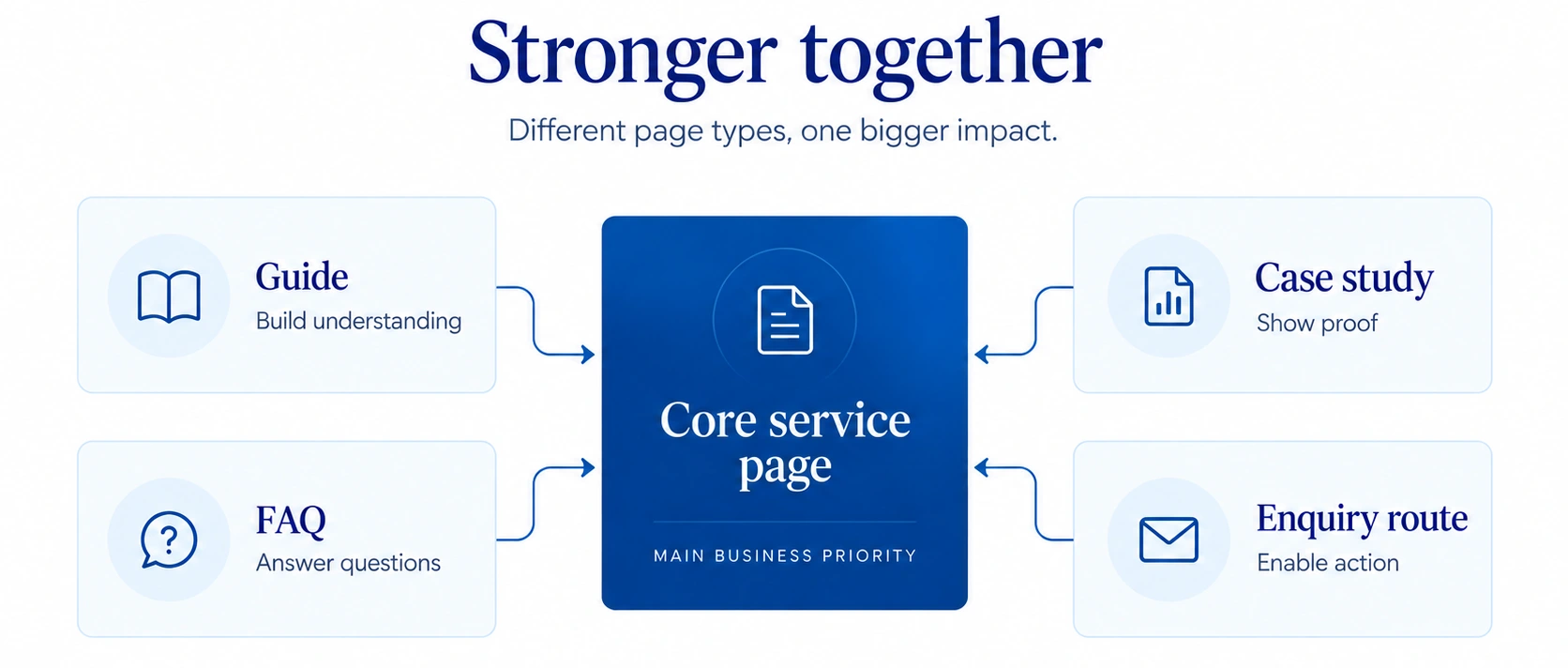
If a service matters to the business, visitors should normally have somewhere focused to understand it. Burying several services within one long page can make it harder to explain who each service is for, how it works, what proof supports it and what someone should do next. Dedicated pages also make it easier to update individual offers as they change.
The goal is not to create more pages for the sake of it. It is to give meaningful parts of the business enough space to be understood.
Use Supporting Pages to Answer Different Questions
Not every visitor arrives ready to enquire. Some need reassurance, examples, detailed explanations or practical information before they are comfortable moving forward. A guide can explain a complex topic. A case study can show how a service works in practice. An FAQ can remove a common concern. A sector page can explain how an offer applies to a particular type of customer.
These pages should support the main commercial structure rather than becoming a separate content library with no obvious connection back to the business.
Let the Website Reflect Growth Priorities
Business strategy changes. A company may enter a new market, introduce a higher-value service, reduce emphasis on an older offer or change the type of customer it wants to attract. The website should be able to reflect those decisions.
Nexus Blueprint's Blueprint Session focuses on identifying a small number of priorities and turning them into specific actions with owners and timelines. The same principle can be applied to a website review. If a new direction matters strategically, ask whether the current site makes that priority visible and whether visitors have an appropriate route through it.
Give Website Content Clear Ownership
Page architecture answers where information should live. Website content strategy also needs to answer who is responsible for that information once the site is live.
This is a common weak point for SMEs. A website launches with accurate service descriptions, team information, examples and calls to action. Six months later, a service changes, a member of staff leaves, or a new process is introduced. Everyone knows the page is outdated, but nobody is clearly responsible for updating it.
Content Marketing Institute describes content governance as the processes, workflows and guidelines an organisation uses to manage content — and highlights how documented workflows can clarify roles and responsibilities. For an SME, this does not need to become a complicated governance programme. A simple ownership model is often enough.
Assign Responsibility by Subject, Not by Website Task
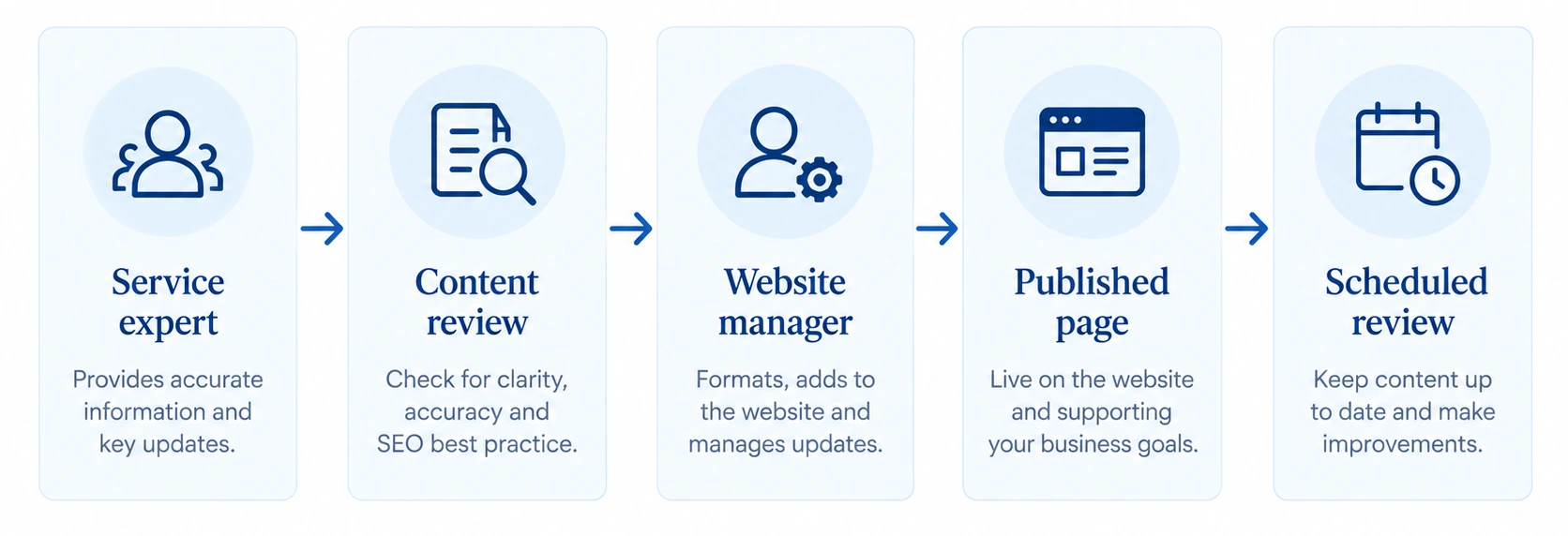
The person who edits a CMS does not automatically know when a service has changed. A more practical arrangement is for the person closest to the subject to own the accuracy of the information, while marketing or whoever manages the website handles presentation and publishing.
For example, a commercial director might own the accuracy of pricing and service positioning, an operations lead might own process information, and marketing might manage how those updates are presented on the site. The important point is that someone is expected to notice when a page no longer reflects reality.
Ownership Should Continue After Launch
A website is often treated as a finished project once it goes live. In practice, it should change as the business changes. Services evolve. Pricing changes. New proof becomes available. Old case studies become less relevant. Team responsibilities move.
Assigning ownership makes those updates part of normal business activity rather than waiting until the website feels obviously out of date.
Build Conversion Paths Around Business Outcomes
A conversion is simply a useful action that moves a visitor towards a business goal. For one company, that may be an enquiry. For another, it could be a booking, consultation request, product purchase, distributor application or specification download. The important part is deciding which website conversions matter and where they should happen.
Using one generic "Contact Us" button across every page can be convenient, but it assumes every visitor has the same level of intent and needs the same next step.
Define the Purpose of Important Pages
Each important page should have a reason to exist. A service page may need to generate qualified enquiries. A case study may need to build confidence and guide someone towards a related service. A detailed guide may exist to answer an early question and then point readers towards deeper commercial information.
Once the page purpose is clear, the next action becomes easier to choose. This also makes performance easier to assess — instead of asking whether a page "gets traffic", the business can ask whether it is helping the right people move forward.
Do Not Use the Same Conversion Everywhere
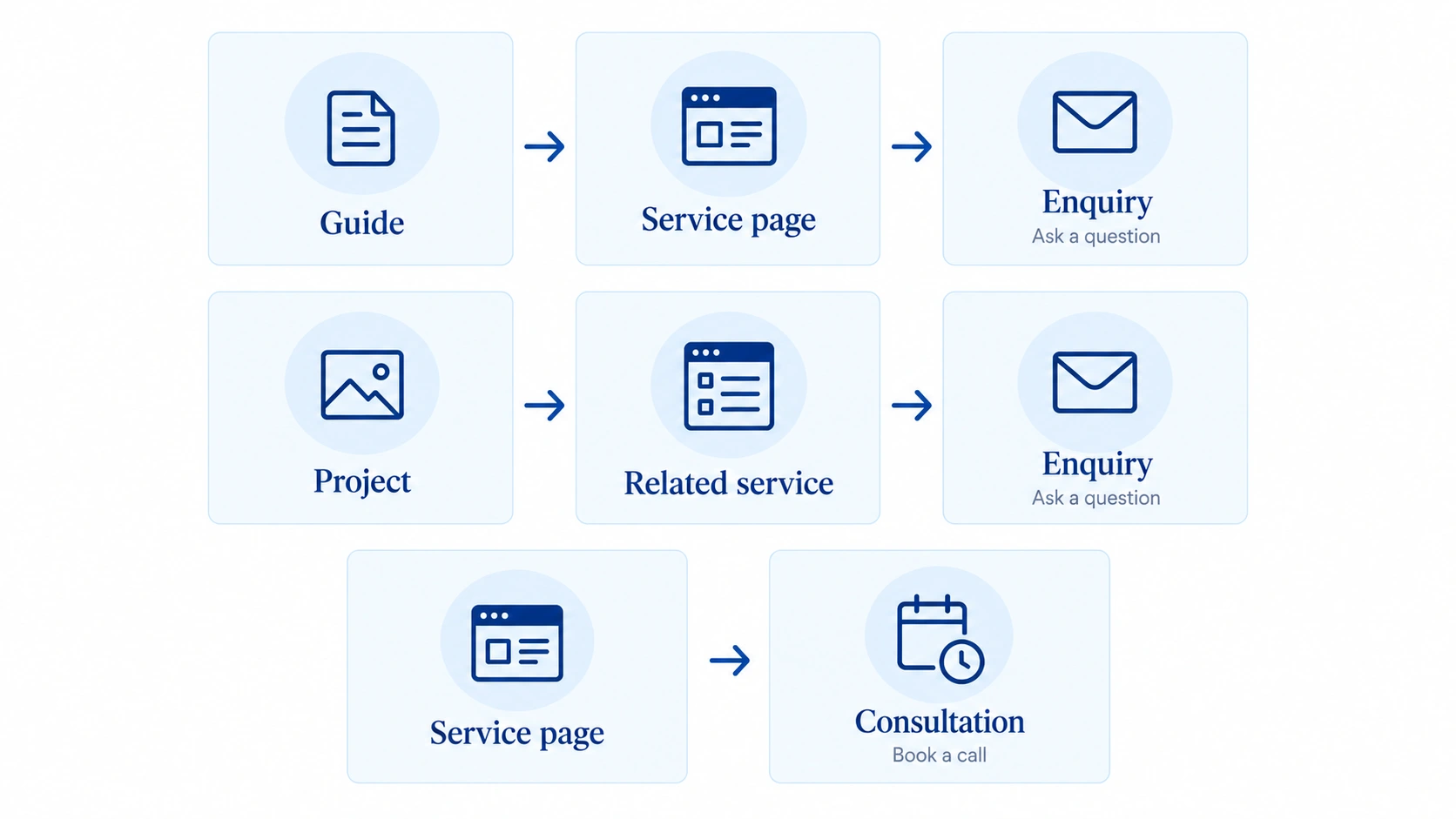
Someone reading an introductory guide may not be ready to book a consultation. Someone viewing a detailed service page may be. A useful conversion path reflects that difference.
An educational article might lead to a relevant service page. A case study might lead to a similar project or service. A pricing page might lead directly to an enquiry. A technical resource might offer a download before presenting a commercial next step. The route should make sense from the visitor's current position rather than forcing everyone towards the same action.
Measure Whether the Website Supports the Strategy
Measurement should start with purpose. The GOV.UK Service Manual recommends defining what a service is trying to achieve before choosing metrics, then selecting measures that help show whether it is working. The same principle applies to an SME website.
If the purpose of a service page is to generate qualified enquiries, page views alone do not tell you enough. If a guide exists to move readers towards a commercial page, it is useful to know whether people actually follow that route. If a sector page was created to support growth in a particular market, the business should be able to see whether it is contributing to relevant enquiries.
Choose Measures That Relate to Business Value
The most useful metrics depend on the business and the page. For a consultancy, qualified enquiry submissions may matter most. For a clinic, completed bookings may be more useful. A manufacturer may care about technical downloads, distributor contacts or quotation requests. The aim is to connect website activity to something the business recognises as valuable.
Review the Journey, Not Just the Final Action
If website conversions are lower than expected, the problem may begin before the final form or booking screen. Visitors may be reaching the wrong page. The service may not be explained clearly enough. The next step may appear too early. Supporting proof may be missing. A useful service may be difficult to find from the navigation.
Looking at the journey helps identify where people lose confidence or direction. That is more useful than simply concluding that a page needs a stronger button.
A Typical SME Website Scenario
Consider an established SME that started with one main service and gradually expanded into three. The original service still dominates the homepage and navigation because that is how the website was organised several years ago. The newer services sit inside one broad page. Different team members send occasional edits to whoever manages the website, but nobody owns the accuracy of the sections. Nearly every page uses the same enquiry button, even though customers often need different information before they are ready to make contact.
The structure of a website that once suited the company now reflects an earlier version of the business.
A sensible review would begin by mapping the current offers and the customers each one serves. The three commercially important services could then be given clearer destinations, with relevant proof and supporting information connected to each one. Responsibility for accuracy could be assigned to the people closest to each service — the website manager would still handle publishing, but the subject owner would be responsible for flagging changes.
Conversion routes could then be matched to intent. A visitor reading an early-stage guide might be directed towards a relevant service page, while someone already viewing a detailed service could be offered an enquiry or consultation.
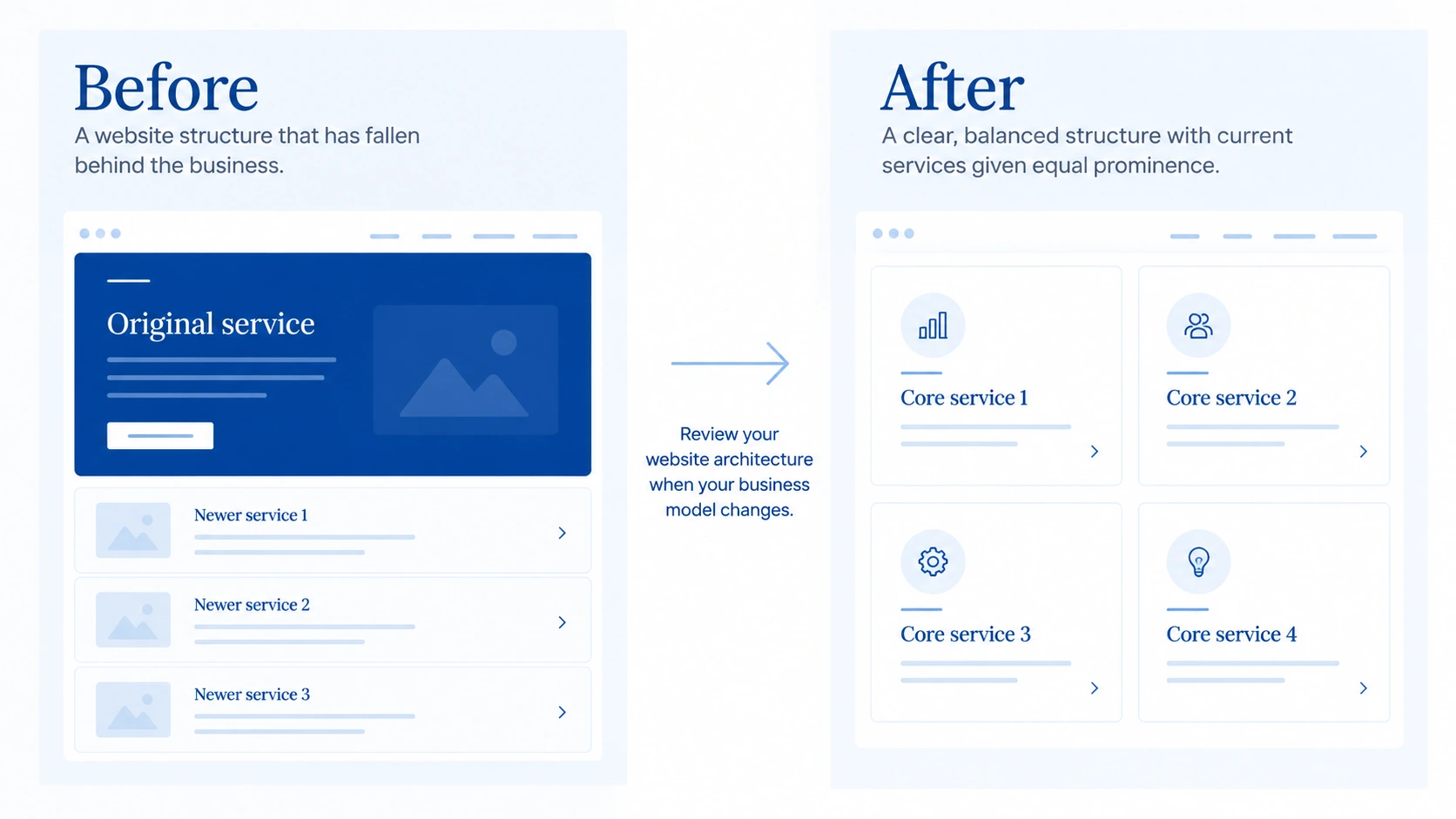
The result is not simply a tidier sitemap. The website becomes easier to manage because its pages, owners and conversion paths reflect the current business.
Signs Your Website No Longer Reflects the Business
Misalignment is not always obvious. The website may still look professional and work perfectly well from a technical point of view. The warning signs are often operational.
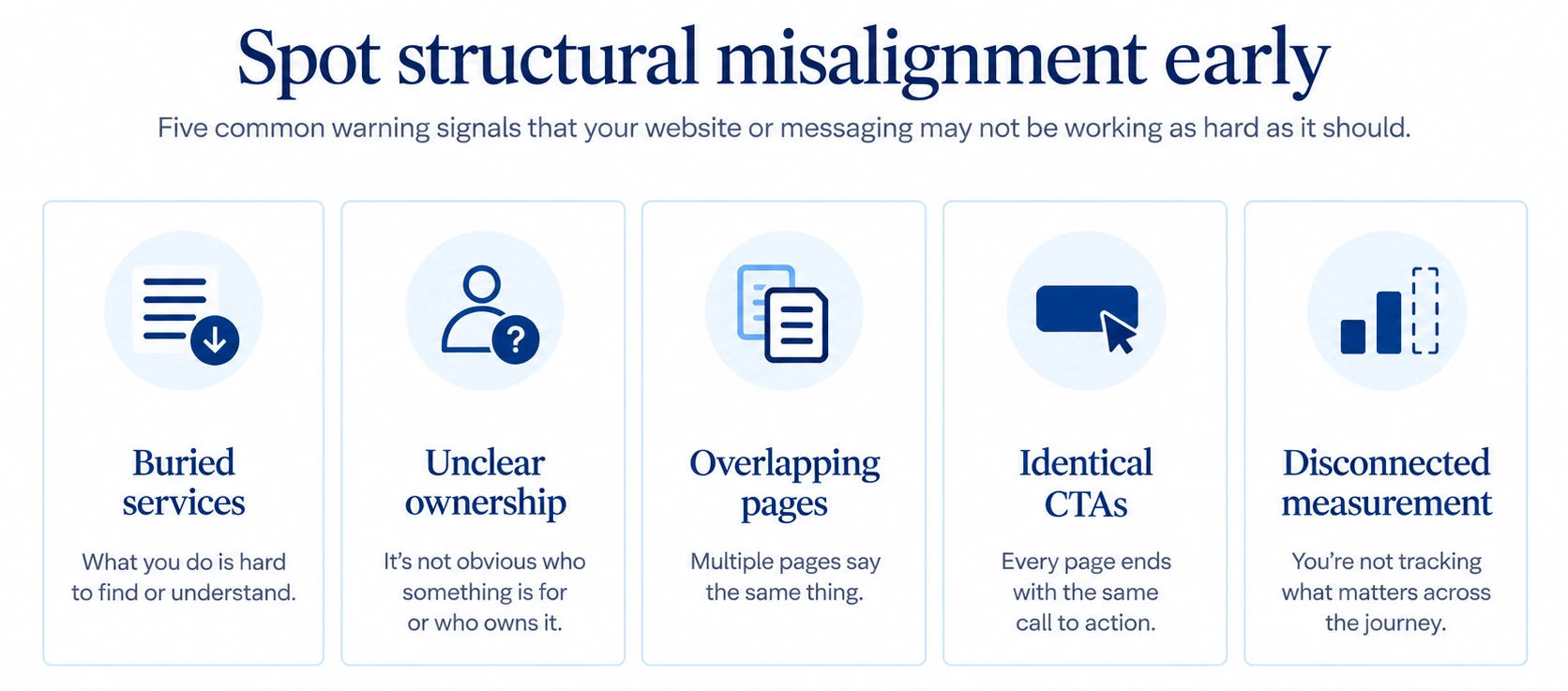
Important Services Are Difficult to Find
If a growing or profitable service is buried inside another page, the website may still be reflecting an older business priority rather than the current one.
Nobody Knows Who Should Update Key Pages
When inaccurate information stays online because everyone assumes somebody else owns it, content responsibility is unclear — and the site gradually drifts further from reality.
Several Pages Compete for the Same Purpose
Over time, businesses often add new pages without reviewing what already exists. This can create overlapping pages that explain similar things without a clear reason for each one, which can confuse both visitors and search engines.
Every Visitor Receives the Same Call to Action
If every page pushes people towards the same action regardless of intent, the conversion path may be too simplistic for the way customers actually make decisions.
The Business Measures Traffic but Not Useful Outcomes
Traffic can show that people are arriving, but it does not show whether the website is helping the business achieve anything meaningful. A structured website review can uncover these issues before they become a reason for a complete redesign. In some cases, clearer page roles, better ownership and more appropriate next steps are enough to bring the website back into line with the business.
Final Thoughts
A website should make the business easier to understand, not force customers to decode how the company is organised internally. That means the page hierarchy, supporting content, ownership and conversion routes all need to connect back to real business priorities.
When the business changes, the website should be reviewed with the same discipline used for other operational assets. New services may need clearer destinations, outdated pages may need a new owner, and useful customer journeys may need to be measured differently.
The structure of a website is most valuable when it reflects how the business creates value today and gives customers a clear route towards the information, service or action that makes sense for them.
About the author: This article was written by Vamos Web Design Agency in Bristol, a web design and SEO agency specialising in helping SMEs build websites that work harder for their business.
Nexus Blueprint retains full editorial control over all guest content published on this site.
Is Your Website Keeping Up With Your Business?
If your site no longer reflects your current services or priorities, a structured review can help. Book a conversation with Richard Shaw at Nexus Blueprint to explore how your digital presence fits into your broader business strategy.
Book a CallFrequently Asked Questions
What Does Website Structure Mean?
Website structure is the way pages and content are organised and connected. It includes the hierarchy between main pages and supporting pages, how visitors move between them and how different areas of content relate to one another. Navigation is part of that structure, but the wider architecture also includes page purpose, content relationships and customer journeys.
How Should Business Strategy Influence Website Design?
Business strategy should help determine which services receive the most prominence, which audiences need dedicated information and what actions the website should support. A business that is changing its service mix, targeting a new market or trying to grow a specific area should check whether the website reflects those priorities clearly.
Who Should Own Website Content in a Small Business?
The person closest to the subject should normally be responsible for accuracy, while marketing or the website manager can handle publishing and presentation. This creates a clearer distinction between knowing when information has changed and having the technical access to update it.
What Counts as a Website Conversion?
A website conversion is any useful action that supports a business objective. It might be an enquiry, booking, purchase, quotation request, consultation, download or another meaningful step. The right conversion depends on the purpose of the page and the way customers buy.
How Often Should an SME Review Its Website Structure?
There is no fixed timetable, but a review is useful whenever the business changes significantly. New services, market expansion, changes in customer focus, team restructuring or a shift in commercial priorities are all sensible triggers. A lighter review once or twice a year can also help identify pages that have become outdated or disconnected from the current business.